
Carpet Stretching vs. Replacement
Wrinkled or worn carpet in your Kansas City home? How Rick decides when stretching or repair saves a carpet and when replacement is the better spend.
By Rick Long, Owner · Updated August 19, 2026
Key takeaways
- If the carpet fiber is still in good shape, the problem is almost always attachment, not the carpet itself. Stretching re-secures it to the tack strips and costs a fraction of replacement.
- Replacement is the honest answer when the carpet is delaminating, threadbare in the traffic lanes, or the padding has broken down through the whole room. Stretching cannot rebuild fiber or padding.
- Age alone does not decide it. A fifteen-year-old carpet in a quiet guest room can be worth stretching, while a six-year-old carpet in a busy hallway can already be past saving.
- Carpet can be re-stretched. A carpet that loosened years after its last stretch, or was installed with a knee kicker instead of a power stretcher, can usually be pulled tight again if the fiber is sound.
- IICRC-certified owner Rick has been making the repair-or-replace call in Kansas City homes since 1991, and we will say plainly when repair is not worth your money. Free estimates at (816) 836-1767.
How Do You Tell If Carpet Needs Stretching or Replacement?
Direct answer
Look at the fiber, not the wrinkles. If the pile is still intact and the problem is loose, rippled, or buckled carpet, stretching fixes it. If the backing is separating, the traffic lanes are worn flat, or the padding has broken down, replacement is the better spend.
The wrinkle itself tells you almost nothing. Wrinkled carpet is an attachment problem: the carpet has come loose from the tack strips that hold it tight along the walls, and gravity plus foot traffic did the rest. The fiber can be in excellent shape while the room looks terrible. So the first thing Rick does on an estimate is ignore the ripples and read the carpet. We look at the pile in the busiest walking path, bend the carpet back at a corner to check the backing, and press on the padding near the trouble spots. Those three checks answer the question in about five minutes. Good fiber on a loose carpet means stretching, and the room looks right again the same day. A carpet that fails the fiber test fails it no matter how flat we pull it, and we will say so before any work starts.
What Problems Does Stretching Actually Fix?
Direct answer
Stretching fixes ripples, buckles, waves, and loose sections by pulling the carpet drum-tight across the room and re-securing it to the tack strips. It also corrects carpet that bunched up after a rushed install, years of traffic, furniture drags, or water damage that has since dried out.
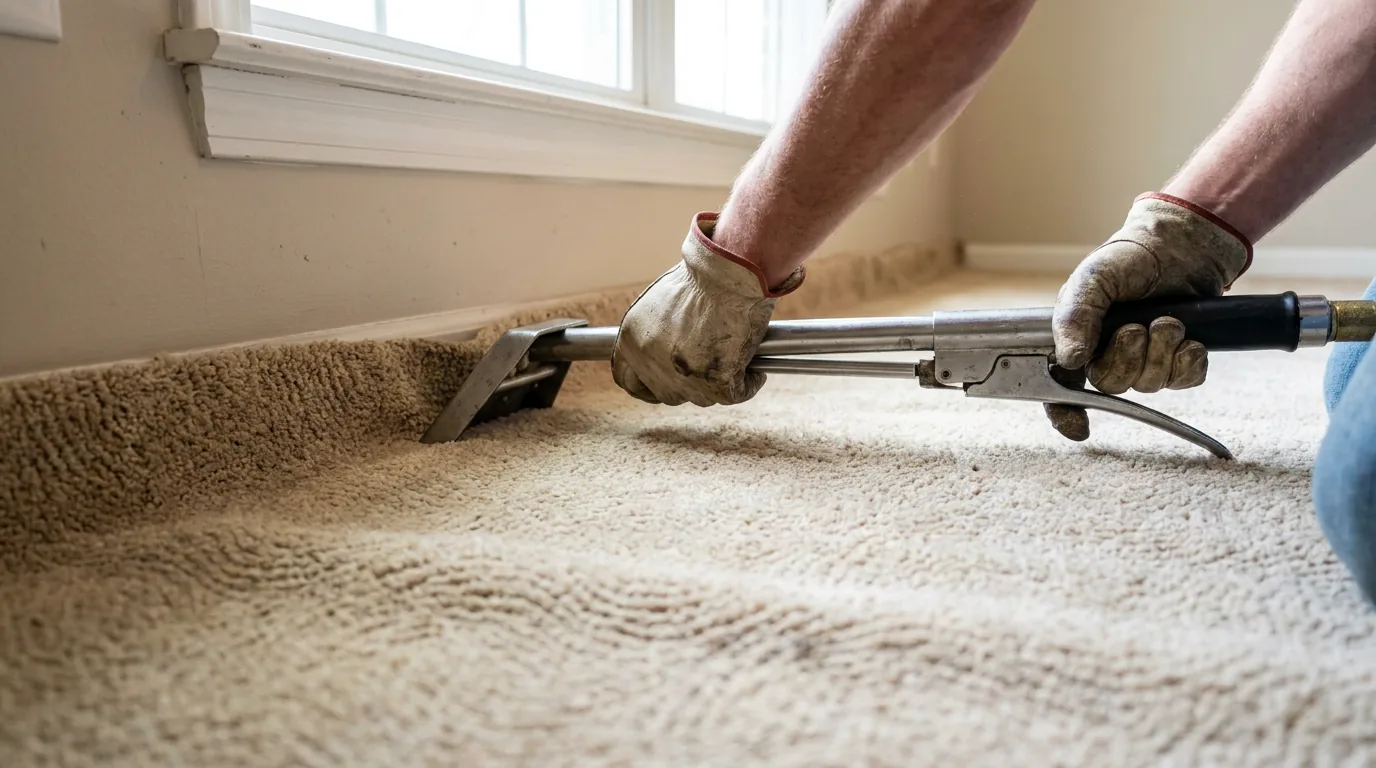
Power stretching re-tensions the whole room, not just the spot that looks bad. That matters because a ripple in the middle of a room almost always means the tension failed at a wall, and chasing the visible wave with a rented knee kicker just moves it somewhere else. We also get asked regularly whether carpet can be re-stretched, and the answer is yes. A carpet that was stretched years ago and has loosened up again, or one that was installed with a knee kicker instead of a power stretcher on day one, can usually be pulled tight again as long as the fiber is sound. There is enough material buried on the tack strip and tucked under the baseboard to give us something to work with. If you want the full story on why carpet ripples in the first place, our ripples guide linked below covers the causes in detail.
When Is Replacement Honestly the Better Answer?
Direct answer
When the carpet is structurally done: the backing layers are separating, which is called delamination, the traffic lanes are worn down to the backing, or the padding has collapsed through the whole room. Stretching cannot rebuild fiber or padding. At that point new carpet is the better use of your money.
Repair work is our business, so it would be easy to say yes to every job. We do not, because a perfectly executed stretch on a dead carpet is wasted money and the customer knows it within a month. Three things move our recommendation to replacement. Delamination is the first: when the secondary backing separates from the primary backing, the carpet wrinkles again no matter how tight it is pulled, because the material itself has failed. Worn-out traffic lanes are the second. Once the pile is crushed flat or worn through in the walking paths, tension will not bring it back. Broken-down padding across the whole room is the third: if the floor feels hard everywhere you step, the pad has finished its life, and replacing pad means pulling up the carpet anyway. Any one of those three, confirmed in person, and we will tell you to spend your money on new carpet instead of on us.
Does Carpet Age Decide It, or Condition?
Direct answer
Condition decides it. Age is a clue, not a verdict. A fifteen-year-old carpet in a guest room that sees light traffic can be worth stretching, while a six-year-old builder-grade carpet in a busy hallway with kids and dogs can already be past saving.
We stretch carpets in Kansas City homes that are older than some of the technicians working on them, and they come out great, because a low-traffic room simply does not wear carpet out. The reverse is also true. Builder-grade carpet in a newer subdivision can be threadbare in the hallway inside a decade, because the pile density was never meant for that much traffic. What matters is how the specific carpet in the specific room has lived. Pile density, fiber type, sun exposure, pets, kids, and whether it has been professionally cleaned on a schedule all age a carpet faster or slower than the calendar does. Berber and loop styles hide wear longer but show damage harder when a loop pulls. So do not let anyone decide over the phone based on the install date alone. The carpet has to be read in person, in the room where it lives.
What About Damage in Just One Spot?
Direct answer
A burn, a bleach spot, or a pet-chewed section near a doorway is patching territory, not replacement. A patch cut from donor carpet in a closet fixes localized damage for far less than new carpet. Save the replacement conversation for carpet that is failing everywhere.
Whole-room replacement over one bad spot is the most expensive possible answer to a small problem, and we see people talked into it more often than you would think. If the damage is localized and the surrounding carpet is healthy, a patch handles it: the damaged section comes out and a piece of matching donor carpet goes in, usually harvested from the back of a closet where nobody will ever miss it. Burns, bleach spots, unraveling seams where two rooms meet, and the spot where a puppy tested a doorway are all patch jobs, not replacement jobs. We wrote a full guide to carpet patching, linked below, that covers how the donor piece is matched and what a finished patch looks like. The short version for the stretch-or-replace decision: spot damage does not count against the carpet. Judge the whole floor, patch the spot.
How Do the Costs Actually Compare?
Direct answer
Replacement means paying for new carpet, new padding, installation, furniture moving, and disposal of the old carpet for the entire room. Stretching or repair is a service call on carpet you already own, at a fraction of that cost. Call (816) 836-1767 for a free estimate with real numbers.
We do not publish flat prices because rooms are not flat-price problems: size, furniture, how the room connects to hallways, and how much work the tack strips need all move the number. But the structure of the comparison never changes. Replacement is a materials purchase plus an installation project. You are buying carpet and pad by the square yard, paying an install crew, emptying the room, and paying to haul away the old carpet. Stretching is one van, one visit, working with the materials already on your floor. That is why a stretch comes in at a fraction of replacement for a room whose fiber is still good, and why it buys years before the replacement conversation needs to happen at all. Our rate is the same across the 28+ metro cities we serve, with no travel surcharge, and the estimate is free. Get the real number for your room before assuming the carpet has to go.
What Happens During a Repair Visit?
Direct answer
The visit starts with an honest read of the carpet: fiber, backing, and padding. Then you get a straight recommendation, whether that is stretching, patching, or replacement. If stretching is the answer, most rooms are pulled tight, trimmed, and re-secured in the same visit.
First comes the assessment, because everything depends on it. A technician checks the pile in the traffic lanes, the backing at a corner, and the padding underfoot, then walks you through what the carpet can and cannot give you. If the call is replacement, you hear that plainly and the visit costs you nothing but a few minutes. If the call is stretching, Rick works the room with a power stretcher, re-secures the carpet to the tack strips, replaces any strips that have rotted or pulled loose, and trims and tucks the edges clean. Padding gets replaced under damaged sections when it needs it, without redoing the whole room. Most single rooms are finished the same day, and stretching pairs well with a professional cleaning once the carpet is tight. IICRC-certified owner Rick has been making this exact call for Kansas City homeowners since 1991, and the estimate is always free.