
Commercial Carpet Cleaning: A KC Guide
How often commercial carpet really needs professional cleaning, what drives the cost in Kansas City, and how offices get deep-cleaned without closing.
By Rick Long, Owner · Updated August 27, 2026
Key takeaways
- Commercial carpet absorbs more foot traffic in a month than most homes see in a year, and janitorial vacuuming only reaches the surface. Professional hot water extraction is what removes the soil grinding away at the fibers underneath.
- For most Kansas City offices, Rick recommends a quarterly deep-cleaning cycle. Heavy-traffic entries and corridors often need attention monthly, while low-traffic suites can stretch to twice a year.
- After-hours scheduling means your business never closes for cleaning. We work evenings, weekends, and early mornings, and commercial carpet is typically dry within 4 to 8 hours, before staff arrive.
- Before hiring any commercial cleaner, ask for a certificate of insurance and IICRC certification. Property managers and building owners should never have to chase that paperwork.
- Commercial cleaning quotes depend on square footage, carpet condition, and frequency. Recurring maintenance plans cost less per visit. R&L walkthrough estimates are free, with no hidden fees.
Why Does Commercial Carpet Wear Out Faster Than Home Carpet?
Direct answer
Volume and grit. A busy office lobby can take more foot traffic in a month than a living room sees in a year, and every step grinds tracked-in soil against the fibers like sandpaper. Vacuuming removes surface debris, but the abrasive grit works downward, cutting fibers and creating permanent traffic lanes.
The carpet in your reception area is fighting a battle your carpet at home never faces. Hundreds of people cross it daily, and each of them carries in a little of the outside world. In Kansas City that means January road salt, February slush, spring mud, and the fine dry grit of August. That soil does not sit politely on the surface waiting for the janitorial crew. Foot pressure drives it down into the pile, where it grinds against the fiber every time someone walks by. This is why commercial carpet develops those dull gray traffic lanes long before the rest of the floor looks worn: the fibers are not just dirty, they are being abraded. Rick has cleaned commercial spaces around the metro since 1991, and the pattern is always the same. The buildings that wait until carpet looks bad have usually waited past the point where cleaning can fully reverse the damage. The buildings that clean on a schedule keep their carpet years longer, and it shows in every first impression their lobby makes.
How Often Should Commercial Carpets Be Professionally Cleaned?
Direct answer
It depends on traffic, not the calendar. Most Kansas City offices do well on quarterly deep cleaning. High-traffic zones like entries, lobbies, and main corridors often need monthly or bimonthly service, while private offices and low-traffic suites can go six months. Medical facilities and daycares usually run tighter cycles for hygiene reasons.
There is no single right answer, and any company that quotes you a frequency before seeing your building is guessing. What actually determines the cycle is how many feet cross the carpet and what those feet bring with them. A professional suite with eight employees and occasional visitors is a completely different animal from an apartment lobby, a church fellowship hall on Sunday, or a medical waiting room that flu season fills. When Rick walks a facility, we map the traffic zones first. Entries and main corridors carry most of the load and usually justify monthly or bimonthly attention. General open office areas typically land on a quarterly cycle. Perimeter offices and conference rooms that see light use can often stretch to semi-annual cleaning without suffering for it. The honest approach is to clean different zones at different frequencies instead of treating 20,000 square feet as one uniform surface. That is how you keep the whole building presentable without paying to deep-clean carpet that does not need it yet.
What Cleaning Method Works Best on Commercial Carpet?
Direct answer
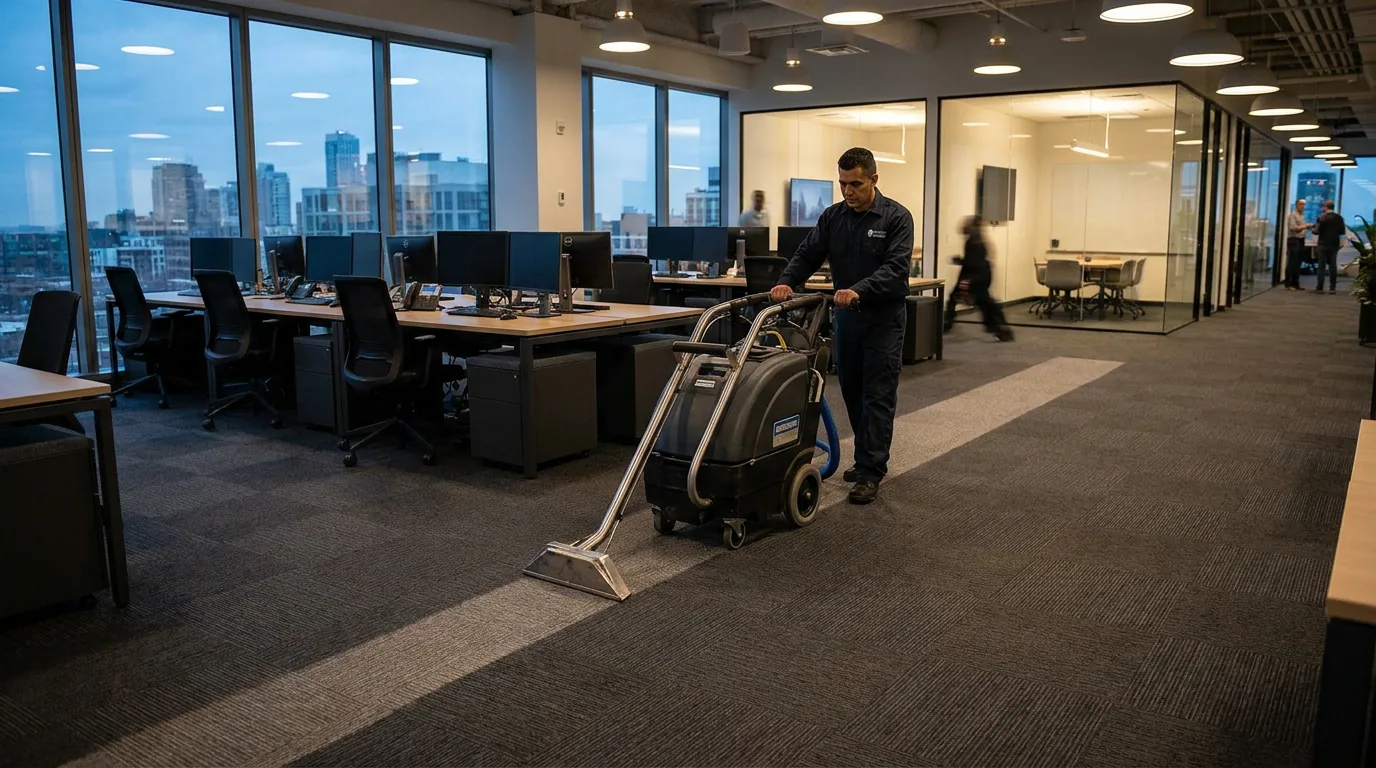
Commercial-grade hot water extraction. It flushes the deep soil that daily vacuuming cannot reach and removes it from the building instead of redistributing it. Low-pile commercial carpet and glue-down tile respond especially well because they hold less water and dry fast, typically within 4 to 8 hours.
Vacuuming is maintenance, not cleaning. Even a disciplined janitorial routine only captures what sits near the surface, and some quick-fix methods simply spread the soil around or leave behind residues that attract dirt faster. Hot water extraction works differently. Heated solution is injected into the pile under pressure, breaking the bond between soil and fiber, and a powerful vacuum immediately pulls the water and the suspended dirt out of the carpet and into the truck. What leaves the building is a tank of gray water that used to be inside your floor. Commercial carpet is actually well suited to this method. Most of it is low-pile or glue-down construction, which holds far less moisture than a plush residential carpet and releases soil readily under strong extraction. Our equipment is commercial-grade, which matters most on the recovery side: the more moisture removed at the wand, the faster the floor dries. If you want the full walkthrough of how hot water extraction works, we wrote a plain-English explainer on it, linked below.
How Do You Deep-Clean an Office Without Shutting It Down?
Direct answer
Clean when the building is empty. We schedule commercial work for evenings, weekends, and early mornings, so operations are never interrupted. With commercial-grade extraction, carpet is typically dry within 4 to 8 hours, which means a Friday evening cleaning is ready for foot traffic before anyone returns Monday.
The most common worry we hear from office managers is not about the cleaning at all. It is about disruption: wet floors, moved furniture, employees stepping around hoses. The answer is that a well-run commercial job should be invisible to your staff. We clean when your space is empty, whether that is after close on a weeknight, over a weekend, or before dawn. By the time employees and customers arrive, the carpet is dry, the furniture is back, and the only evidence is that the traffic lanes are gone. Dry time is the detail that makes this work. Because commercial extraction recovers most of the moisture during cleaning, commercial carpet is typically walkable within 4 to 8 hours. Kansas City summers add humidity that can slow drying in a sealed building, so on those jobs we plan airflow accordingly. Before any of this happens, Rick walks the facility personally, notes the problem areas and the schedule constraints, and builds the plan around your hours. You tell us when the building is empty. We handle the rest.
What Should You Look For in a Commercial Carpet Cleaner?
Direct answer
Proof, not promises. Ask for a certificate of insurance, IICRC certification, and references from facilities like yours. Then ask who actually shows up: a rotating franchise crew or the same experienced technician every visit. Consistency is what keeps quality stable across a recurring schedule.
Commercial work has requirements residential customers never think about. If you manage a building, you already know the first one: insurance documentation. Any cleaner working in your facility should carry full liability coverage and hand you a certificate of insurance without being chased for it. We keep COIs ready because property managers need them before work begins, not after. Certification matters too. IICRC training is the industry standard for cleaning science, and it is the difference between a technician who understands fiber types and one who points a wand at everything. The question fewer people ask is about consistency. Large franchise operations often send whoever is available, which means the person cleaning your building in March has never seen it before. With R&L you get the same experienced technician on every visit, someone who knows your building, your trouble spots, and your schedule. That consistency shows up in the results, and in the fact that you stop having to explain the job every time. Accountability is simpler when the company is local, owner-operated, and has served the metro since 1991.
What Does Commercial Carpet Cleaning Cost in Kansas City?
Direct answer
It depends on square footage, carpet condition, layout, and how often you clean. Recurring maintenance plans cost less per visit than one-time deep cleans because maintained carpet cleans faster. R&L quotes are based on a free in-person walkthrough, and the number you get is the number you pay.
Nobody can price a commercial job honestly over the phone, and we do not try. The real cost drivers are the size of the space, the condition the carpet is in when we arrive, how the furniture and layout affect access, and the frequency you choose. A building on a quarterly plan costs less per visit than a one-time restoration clean, for a simple reason: carpet that never gets truly filthy takes less time, less chemistry, and less effort to bring back. Frequency is not just better for the carpet, it is better math. The other cost people forget is replacement. Commercial carpet installation is a major capital expense, and ground-in soil is what shortens carpet life. A maintenance plan that extends replacement by even a few years pays for itself many times over. What we can promise up front is how the quote works: Rick assesses the space in person, the walkthrough is free, and the estimate includes everything. No fuel fees, no surprise add-ons, no travel surcharge anywhere in the KC metro. Call (816) 836-1767 and we will put a real number on your building.
Is a Recurring Maintenance Plan Worth It for Your Facility?
Direct answer
For most commercial spaces, yes. Monthly, quarterly, or semi-annual plans keep carpet consistently presentable, cost less per visit, and extend the years between replacements. Property managers get the added benefit of one vendor handling scheduled maintenance, common areas, and unit turnovers on a predictable calendar.
A one-time deep clean fixes today's problem. A schedule prevents next year's. We offer monthly, quarterly, semi-annual, and fully custom cadences, matched to how each part of your facility is actually used. Offices usually settle into quarterly service. Churches often plan around their calendar, with fellowship halls and nurseries on tighter cycles than sanctuaries. Medical and dental offices run more frequent cleanings in waiting areas for sanitation. Apartment and multifamily managers tend to combine two needs: scheduled common-area maintenance for hallways and lobbies, plus on-demand unit turnovers, and we handle multiple units in a single visit to keep vacancy days down. Retail floors, showrooms, schools, and daycares each have their own rhythm, and we have cleaned all of them, from 500 square foot suites to facilities of 50,000 square feet. The practical advantage of a plan is that presentation stops being something anyone has to remember. The schedule exists, the same technician shows up, each visit is logged, and the carpet simply never reaches the point where a visitor notices it for the wrong reason.